Decoding the AI Gold Rush: 7 Business Models Powering the Forbes AI 50 (And How to Use Them)
The hype surrounding Artificial Intelligence is deafening, but beneath the noise, real companies are generating serious revenue and solving actual problems.
For entrepreneurs and founders looking for their next big idea, staring at the giants like OpenAI or Google can be paralyzing. You likely aren't going to raise billions to train your own foundational model. But the good news is: you don’t have to.
I recently analyzed the data from the newly releasedForbes AI 50 2025 List, which ranks the most promising private AI companies. Instead of just looking at who made the list, I looked at what they are selling.
By categorizing these 50 powerhouses based on their core value propositions, distinct patterns emerge. These patterns aren't just academic—they are blueprints for the next wave of AI business opportunities.
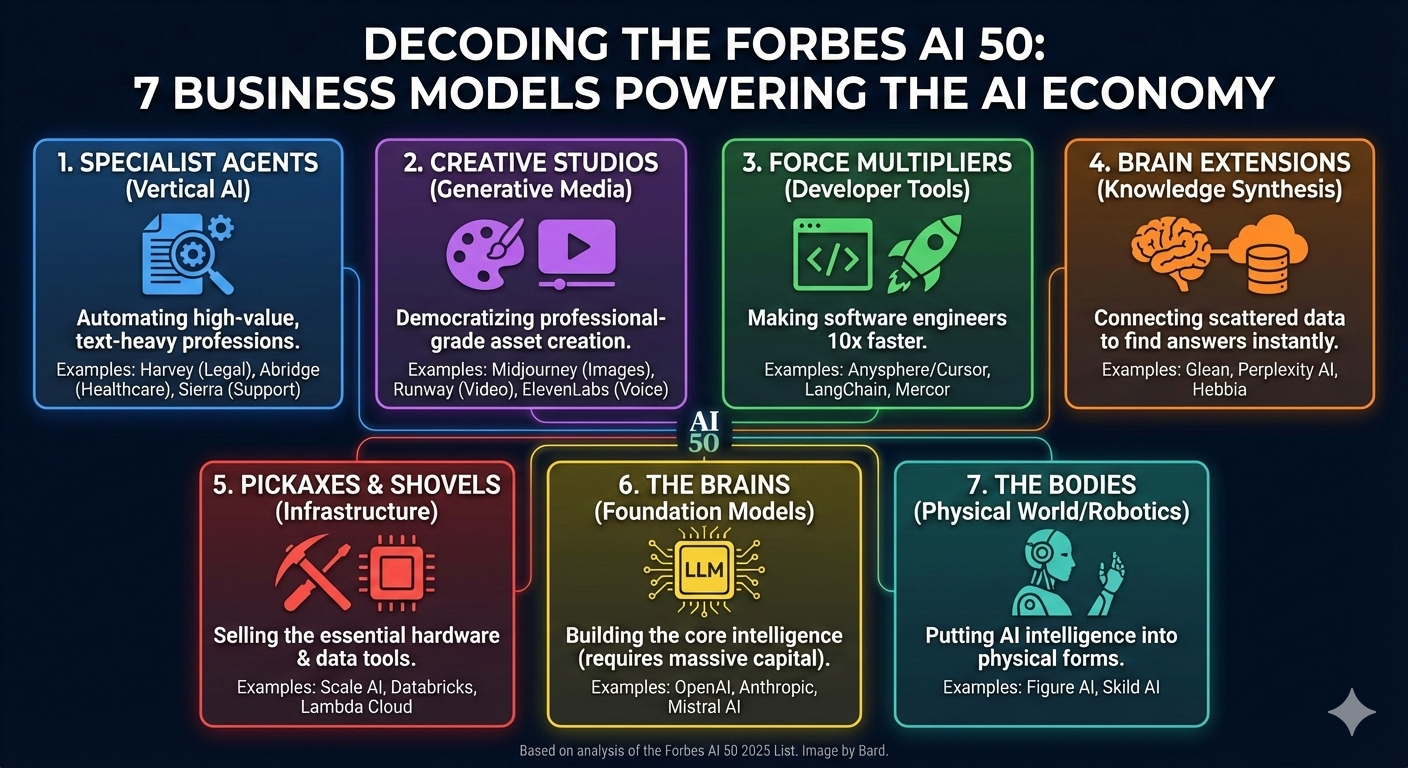
Here are the 7 successful business models driving the top AI companies today, and the entrepreneurial takeaways for building your own.
1. The "Specialist Agents" (Vertical AI)
The Pattern: These companies don't try to be everything to everyone. Instead, they identify a single, high-value, expensive profession—usually one drowning in text and regulations—and build highly specialized AI to automate the drudgery. They win by going deep, offering accuracy and compliance that generic models can't match.
- Who's doing it:
- Harvey & Luminance: Automating low-level legal research and contract review.
- Abridge & OpenEvidence: Summarizing doctor-patient conversations and mining medical journals for answers.
- Sierra & Decagon: Specialized autonomous agents for complex enterprise customer support.
- The Entrepreneurial Takeaway: Stop trying to build "ChatGPT for X." Instead, identify an expensive professional service loop that involves reading complex rules, synthesizing data, and writing reports.
- Idea Angle: An AI agent specifically for summarizing construction site manager meetings, or a tool that automates grant writing for non-profits.
2. The "Creative Studios" (Generative Media)
The Pattern: These tools democratize creativity. They allow a single person—a marketer, a small business owner, or an indie creator—to produce professional-grade assets that used to require an entire studio and expensive equipment. They sell "creative superpowers."
- Who's doing it:
- Midjourney, Runway, & Pika: Generating high-fidelity images and video from text.
- ElevenLabs & Suno: Creating realistic voiceovers and full musical compositions.
- Captions: AI-powered video editing specifically for social media creators.
- The Entrepreneurial Takeaway: Don't try to build the next general image generator. Instead, build a generative tool that fits perfectly into a specific, existing workflow.
- Idea Angle: A plugin that auto-generates texture assets specifically for indie game developers, or a tool that automatically translates and dubs YouTube videos for creators expanding to new markets.
3. The "Force Multipliers" (Developer Tools)
The Pattern: Software engineers are expensive and in high demand. These companies build tools that make engineers 10x faster by automating code writing, debugging, deployment, or hiring. They sell direct productivity gains to technical teams.
- Who's doing it:
- Anysphere (Cursor) & Windsurf: AI-native code editors that act as programming partners.
- LangChain: The framework providing the "glue" for developers building LLM applications.
- Mercor: Using AI to vet and hire engineers.
- The Entrepreneurial Takeaway: Software development is a massive, complex process. Find the most painful, repetitive parts that haven't been solved yet.
- Idea Angle: An AI that specializes in writing and running QA test cases, or a "migration bot" that automatically updates old codebases to newer versions of a framework.
4. The "Brain Extensions" (Knowledge Synthesis)
The Pattern: Modern enterprises are drowning in scattered information across Slack, Google Drive, and the web. These companies connect to these messy data silos and allow users to ask natural language questions to find answers instantly. They turn "search" into "synthesis."
- Who's doing it:
- Glean & Hebbia: Enterprise search engines that connect internal company apps to find buried knowledge.
- Perplexity AI: A conversational "answer engine" for the web that provides cited sources.
- The Entrepreneurial Takeaway: Generic search is crowded by giants. Focus on "synthesis" for very specific, messy data types where accuracy is paramount.
- Idea Angle: An AI tool that digests thousands of pages of "Government RFP" documents to summarize requirements for contractors, or a tool that organizes a company's chaotic Discord community history into a searchable knowledge base.
5. The "Pickaxes & Shovels" (Infrastructure)
The Pattern: During a gold rush, the surest bet is selling pickaxes. These companies don't build the end-user apps; they provide the essential infrastructure—the chips, cloud hosting, data cleaning, and serving tools—that everyone else needs to run their AI.
- Who's doing it:
- Scale AI & Snorkel AI: Providing the massive amounts of labeled, high-quality data needed for training.
- Lambda, Together AI, & Crusoe: Offering the specialized GPU cloud compute needed to run models.
- Databricks: The unified platform for managing enterprise data.
- The Entrepreneurial Takeaway: Building a GPU cloud is capital-intensive. However, the "data" side of infrastructure is accessible.
- Idea Angle: A boutique service that cleans, reformats, and structures messy proprietary datasets for small businesses so they can fine-tune their own models (e.g., "Clean up my 10 years of messy customer support logs").
6. & 7. The "Brains" and The "Bodies"
The Pattern: These are the moonshots. The "Brains" are the capital-intensive labs building the foundation models (like OpenAI, Anthropic, and Mistral AI). The "Bodies" are taking that intelligence into the physical world through robotics (like Figure AI).
- The Entrepreneurial Takeaway: For 99% of founders, the play here is simple: Don't compete with them. You cannot out-spend them on compute. Instead, build your business on top of their APIs, using the models they spend billions developing to power the niche applications listed in patterns 1 through 4.
Data source attribution: All company data and rankings are based on theForbes AI 50 2025 List.